Muslim panel answers anonymous questions

**This article was originally published in The Signal on April 17, 2017**

By Hannah Fakhrzadeh
Staff Writer

“I don’t feel oppressed. I feel liberated.”

For Abrar Ebady, a senior biology major, wearing a hijab is not how the media portrays it. While wearing the hijab started at a young age for Edady, it is ultimately her choice to continue.

“The hijab is really about modesty,” said Farsha Rizwan, a senior biology major.

Hosted by the Muslim Students’ Association, “Ask A Muslim” was held on Wednesday, April 12. It provided students the opportunity to ask questions to a panel consisting of students and two special guests about the misconceptions of Islam and life as a Muslim in America.

“(The event) is a great way to learn about another religious group on campus and it provides students and faculty alike (the chance) to have their questions answered,” said Zahra Memon, MSA’s public relations co-chair and a sophomore deaf education and iSTEM double major.

At the event, questions were anonymously submitted to ensure students felt comfortable asking about a range of topics.

“We want everyone to be honest with asking whatever they are curious about,” said Alizeh Shamshad, MSA’s public relations co-chair and a sophomore biology major. “By keeping it anonymous, nobody needs to worry about potentially offending someone due to their question, as we would love to answer every question you have. No question is offensive, as the end goal of each question is to develop a greater understanding and facilitate awareness.”
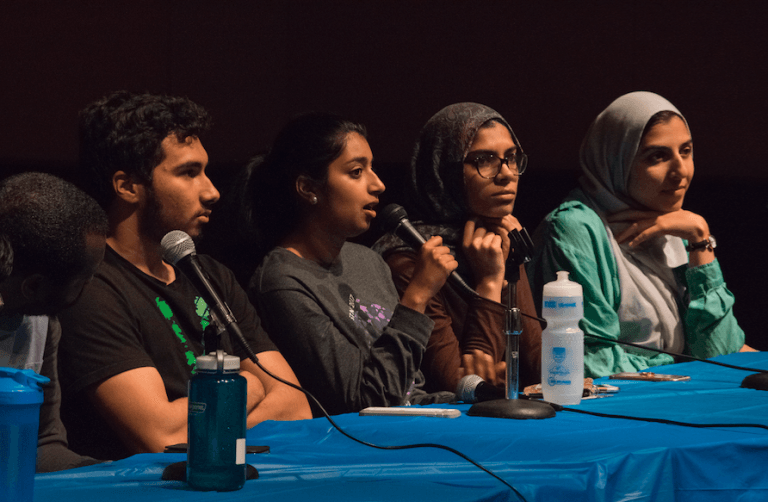
Panelists share what it’s like to be Muslim in America. (Jason Proleika / Photo Editor)

Sameera Chaudry, a general member of MSA and a junior biology major, agreed.

“This kind of open discussion can serve to unite the TCNJ community by fostering an atmosphere of understanding and unity,” she said.

Dr. Mateen Khan, a guest speaker, physician and a Muslim community leader who has dedicated his life to studying and teaching the Quran, believes the panel helped students better understand each other.

“Panels like these help to break down these walls and help us understand one another as fellow human beings,” he said. “Islam is a beautiful religion which over a billion people attribute themselves to. It is worth sharing and understanding.”

Yaseen Ayuby, a panelist and a junior applied mathematics major, reminded the audience to learn for themselves and to “take what you see on the media with a grain of salt.”

Ebady further explained educating oneself and directed the audience to a book titled “The Sealed Nectar” in which she calls, “a beautiful interpretation of Islam.”

The second guest speaker, Kieran Webster, a Rutgers University–New Brunswick graduate student studying business strategy and human resource management, loves the journey Islam has taken him on. Webster wasn’t born into an Islamic family. Instead, he made the choice to convert from Christianity to Islam about three years ago.

“Islam is a religion of logic. The foundation of our religion is ‘as salaamu `alaykum’ which means ‘May the peace and security of God be upon you.’” Webster said. “It elevates us beyond bias, prejudice or bigotry because with this greeting, we are made aware that we worship one God and we seek peace by being peaceful with one another.”

After a question inquired about the injustices of the panelists, Ebady and Nawal Mubin, a sophomore communication studies major, shared their stories.

Mubin described a moment she had with a supermarket shopper. She said, at first, she was unsure how the interaction would pan out. She soon realized that the woman was genuinely interested in learning about her culture.

Ebady recalls a time she passed a group of guys on her walk home from a party. As she passed, she heard them call out “terrorist.”

“I was genuinely afraid for my life,” Ebady said.

While the event allowed the panelists to share their stories, it also became a learning experience for both the audience and panelists.

“I learned more about my religion than I expected tonight,” said Roshaan Iqbal, a sophomore biology major and one of the student panelists for the event. “There were some concepts about my religion that I didn’t even fully understand, and even I got some of those concepts and ideas cleared up.”

Liana Shehata, MSA’s historian and a sophomore psychology major, said Muslim Americans are just average Americans.

“We go through the same struggles and live our lives normally here in the States — we just have beliefs and cultures that differ from the Western culture, and different isn’t necessarily bad,” she said.

**This article was originally published in The Signal on April 17, 2017**
Students talk injustice at monologues

**This article was originally published in The Signal on April 10, 2017**

By Hannah Fakhrzadeh
Staff Writer

“We close our eyes so we don’t have to see the children’s blood-soaked school uniforms, their still sizzling flesh or their bodies contorted in terrible positions.”

For junior biology major Sameera Chaudhry, the horrible scenes displayed in the media of war-torn Syria and the innocent faces of lives that were lost are forever etched in her mind.

Chaudhry discussed the daily injustices that occur around the world, yet most people choose to turn a blind eye.

Students gathered on Thursday, April 6, in the Education Building to hear the Muslim Students’ Association’s Justice Monologues, where students discussed issues of injustice, both in their lives and around the world.

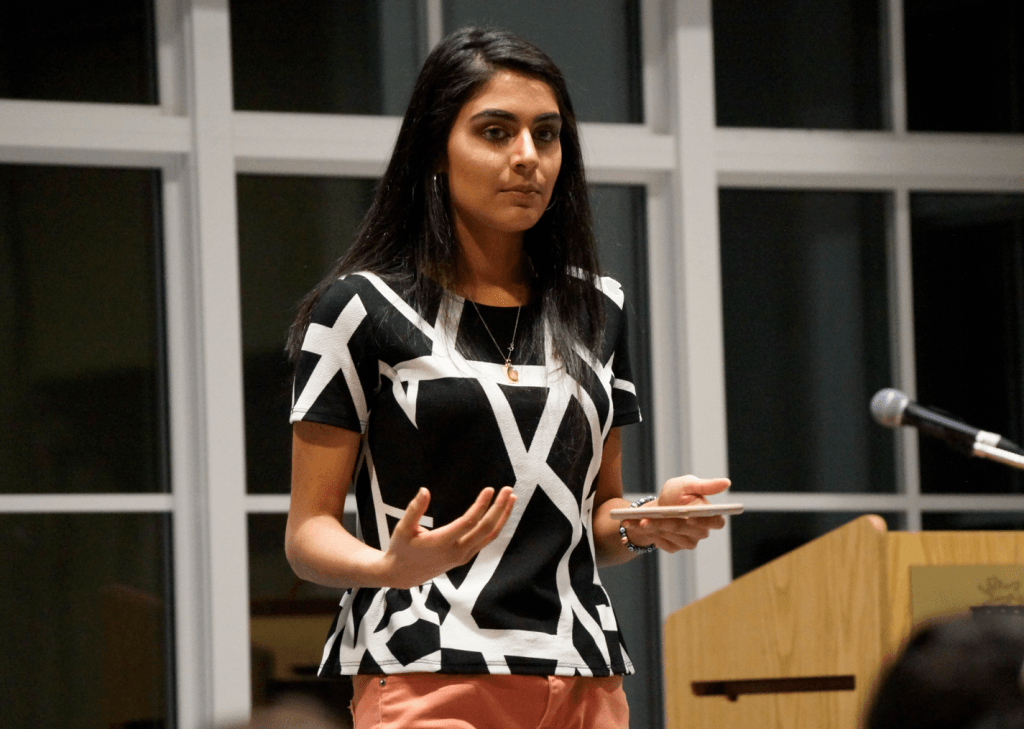
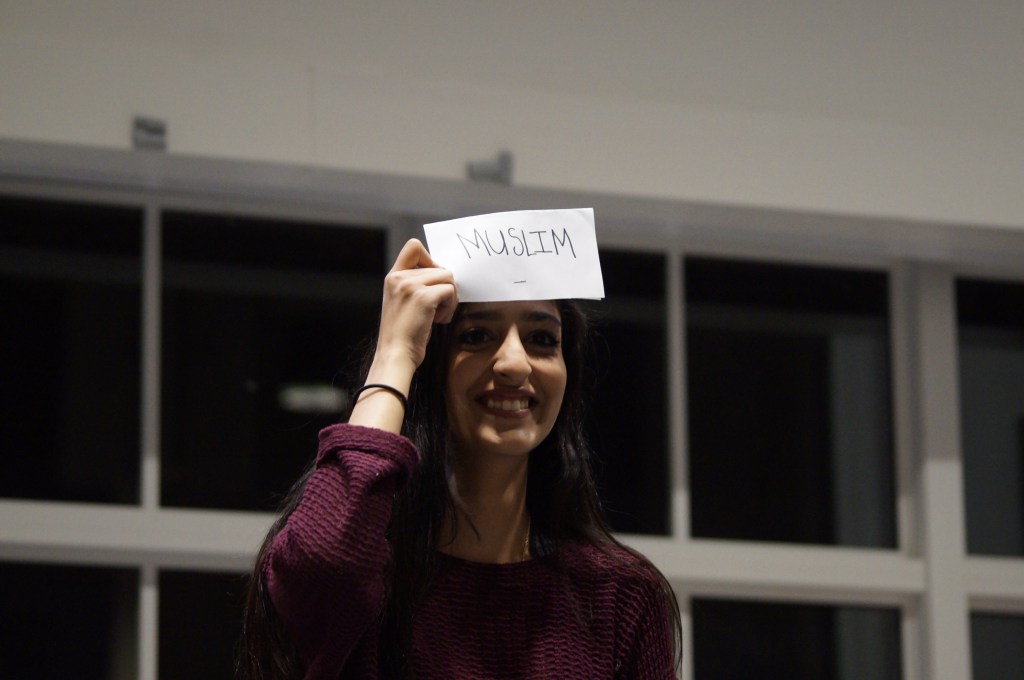
Student embraces muslim identity. (Meagan McDowell / Staff Photographer)

In her monologue, Nawal Mubin, a sophomore communication studies major, pointed out that our nation has witnessed various movements supporting minorities that don’t feel equally represented.

“We say everyone is equal, but we still have (so many) movements for minorities,” she said.

Mubin also brought up the lack of justice in cases like the shooting of Trayvon Martin.

“How can we sit back when we know innocent lives are taken every day?” she asked the audience.

Kyle Kulaga, a freshman career and community studies major, shared a touching story about struggling with his hearing disability in school because some of his teachers did not use American Sign Language in their classes.

“Do you think it’s fair for someone with hearing loss to go through what I went through?” he asked. “I don’t think so, and I want people to know that American Sign Language was a big part of my life.”

Iman Khan, a sophomore biology major, shared an empowering story of overcoming differences in her monologue entitled, “A Triumph of the Conscience.”

“Why am I different? What makes me different?” Khan remembers asking in regard to her darker hair and skin.

Eventually, Khan realized that she should be proud of her identity and not let the opinions of others affect how she sees herself.

Monologues encourage open-mindedness. (Meagan McDowell / Staff Photographer)

“I am me and me is what they will see,” she said.

Matthew Hardy, a senior sociology and women’s, gender and sexuality studies double major, explained an enlightening encounter he had with a Muslim man who gave him a Holy Quran.

“We are all humans,” he said. “I encourage everyone to really listen because you never know what you will learn.”

The Justice Monologues not only provided students the opportunity to tell their stories, but inspire those in attendance, as well. Engy Shaaban, a junior special education and psychology double major, developed a new perspective following the event.

“I think in this day and age, ignorance and especially close-mindedness can be so incredibly dangerous,” she said. “For me, coming to these sorts of events is a way to be exposed to different perspectives that I might not typically have access to.”

The feeling was mutual for Zainab Rizvi, a member of MSA and a junior elementary education and women’s, gender and sexuality studies double major.

“Many people live in their own bubble, and it’s important that they come out and hear the experiences of others,” she said. “It’s a way to appreciate the lives of others and understand that people come from all backgrounds.”

Zahra Memon, MSA’s public relations chair and a sophomore deaf education and iSTEM double major, shared her thoughts on the event.

“We’ve all faced some type of injustice in our lives, and even if we haven’t, someone who shares our ethnicity or culture has been affected in some way,” she said. “The Justice Monologues are a way for all of us to come together and hear the stories of students who have felt injustice.”

Memon believes it is important for students to empathize with their peers.

“We often forget to put ourselves in the other person’s shoes, however, this event will give us the chance to see the other end of the lens,” she said.

**This article was originally published in The Signal on April 10, 2017**

ONE-OF-A-KIND TREEHOUSES FOR HIGH-END CLIENTELE

**This article was previously published in Unique Homes**

SWINGING THROUGH LUXURY

By Hannah Fakhrzadeh


San Francisco builder Barbara Butler hand-designs and crafts elaborate play structures for children combining childhood fantasies with architectural know-how. Her client list includes Gwen Stefani, Will Ferrell, Robert Redford, Will Smith and Jada Pinkett-Smith, Kevin Kline and Phoebe Cates, and Walt Disney Productions. The structures range from small, cozy cabins to big tree houses to large play forts complete with monkey bars, rope swings, bridges and anything the imagination can conjure.

**All photos courtesy Barbara Butler Artist-Builder Inc.**

**This article was previously published in Unique Homes**

Q&A WITH LUXURY DEVELOPER KEVIN VENGER

**This article was originally published in Unique Homes**

ACCLAIMED DEVELOPER TRANSFORMING MIAMI SKYLINE

Unique Homes sat down with Kevin Venger to discuss his experience designing ultra-luxury buildings, working with industry greats, and meeting buyer demands.

By Hannah Fakhrzadeh


Kevin Venger, the co-developer behind Miami’s RegaliaTen Museum Park and Paramount on the Bay always has been intrigued by the concept of developing and designing beautiful and luxurious buildings. “I have been developing, designing and building since I was a child. From my first self-performed treehouse to the art of the high-rise tower, I have always been intrigued by the concept.” To find out more about Venger’s designs and concepts, we sat down with him to see what he had to say.

What peaked your interest in building and developing in the luxury real estate market?

I am always fascinated by the near-endless possibilities of the luxury real estate market, because the buyer’s demand is not the norm. The ability to implement first-to-market materials, finishes and work with the world’s best designers affords a sense of excitement and thrill for me.

Considering the fact that the expectations are high for properties in the industry, what are some of the hyper-specific design needs billionaires are asking for?

Billionaires with multiple homes around the world no longer want to invest extensive time into building out a new residence’s interior space, which often can take two years to complete and requires time involved in the selection process when working with an interior designer. Rather, they are seeking a more turnkey experience in which they can purchase a home with the millwork, finishes and often interior furnishings already in place to quickly move in. 

Requests such as floating staircases and glass-faced pools are becoming more common. How do you explain the rise in the desire for such artistic elements? 

Today’s home needs to equally be artistic and functional. Rare and unique elements are serving more than ever as conversation pieces, which are memorable to those who visit the residence and on a daily basis for the owner. From the floating staircase to the glass-faced pool in Regalia’s $35 million Beach House condo residences currently for sale, one cannot escape the exclusive sense of place in this home because of its one-off features. Those who purchase a residence such as this demand no less, and want to ensure their living experience cannot easily be replicated. 

Can you discuss the climate of Miami’s $20 million and up real estate market?

While certain regions of the world have experienced financial woes, the ultra-luxury sector remains insulated and continues to draw interest due to its long-term value within the marketplace. As a result, the ultra-affluent market does not tend to fluctuate in the same manner. 

Where do you see the market going in the future?

Miami is poised to reach a level of global attention as it continues to grow. With increased activity from China, Dubai and beyond, the next 10-15 years of Miami’s legacy will be defined by new foreign interest and prime investment opportunities for those who deem the city as the “new” London or New York in terms of projected future prices and its art, culture and lifestyle.

This slideshow requires JavaScript.

Interior renderings courtesy ARX Solutions. Exterior, Pool and Balcony photos courtesy Catapult 13.

One of your developments, Regalia, is one of Miami’s most sought-after oceanfront towers. Can you discuss the inspiration and idea behind it and what can be expected from it?

Our level of expectation exceeded the archetypal luxury condominium found in Miami, with our finishes comparable to the finest residences in New York City. For our buyers, we sought to create a curated living experience that was highly intimate in nature, with only 39 residences each residing on their own private full floor, which is very unique to the U.S., and further transcends beyond their residence into the amenity spaces in order to still feel livable and residential.  

Inspiration behind Regalia’s exterior are the waves and wind; we felt it was important to have a meaning to its façade and be place-specific. The design embodies the beauty of Sunny Isles Beach and its oceanfront surroundings. Given Regalia’s location, the building marks the gateway between Sunny Isles and Golden Beach, so its design must be impactful, yet welcoming.

For the interiors of the residences, you tasked Charles Allem to design it. What made you choose to use Allem?

Charles Allem is a master at designing truly livable interior spaces that appeal to all tastes. Being that Regalia has many international residents, it was crucial to design for everyone, with subtle mixes of materials, color, textures and artwork that seamlessly work together. Allem created an ambience that flows to naturally unify the interior and exterior design palate. 

Another design you are behind is 1000 Museum; can you discuss the idea behind that and what it offers?

1000 Museum celebrates an exterior facade (“exoskeleton”) design accentuated by curvaceous flow that continues elegantly into the interiors. This concept has never been seen on this side of the world. 1000 Museum will greatly make a design impact within the downtown Miami urban setting, forever changing the skyline as a visionary masterpiece. As the only ultra-luxury building in the area with just 83 residences, it will remain a legacy project for Miami and another for Zaha Hadid.

The architect behind 1000 Museum is Zaha Hadid. Can you describe Hadid and her legacy? 

Her legacy speaks for itself already. She is one of the most fabulous individuals and unique designers that I have ever worked with. Since Miami will mark her first high-rise residential tower in the Western Hemisphere and her love of the city was well known (as she had a permanent residence here), 1000 Museum is really special project that adds to her worldwide legacy.

You’re behind many other luxury buildings like the Four Seasons Hotel & Residences Miami, Ten Museum Park and Paramount on the Bay. What have you learned from developing these projects that helped you with Regalia?

A residential project’s design, services, operations and use of materials all have to be in perfect harmony in order to create an ultra-luxury, five-star lifestyle experience. These elements cannot function on their own for true luxury to exist.

This slideshow requires JavaScript.

Exterior photos courtesy Ken Hayden. Interior photos courtesy Morris Moreno. Beach House renderings courtesy Neoscape.

**This article was originally published in Unique Homes**

Dreaming on Cloud Nine

DOES YOUR PRINCESS DREAM OF RESTING HER HEAD ON AN AIR BALLOON? DOES YOUR PRINCE DREAM OF SLEEPING IN HIS VERY OWN CAR-SPIRED SUITE?
CIRCU PROVES THESE DREAMS ARE POSSIBLE WITH LUXURIOUS DESIGNS FIT FOR YOUNG KINGS AND QUEENS.

By Hannah Fakhrzadeh

**This article was originally published in Unique Homes**

**This article was originally published in Unique Homes**

IMM celebrates largest graduating class

**This article was originally published in TCNJ’s The Signal on March 3, 2017**

By Hannah Fakhrzadeh
Staff Writer

Due to heightened interest in interactive multimedia, the College’s department will celebrate its biggest graduating class.

This May, students will take part in IMM history, according to Rachel Lichtenberg, the IMM department’s program assistant.

“IMM had three graduating seniors in its first class, and we will now have 44 graduating seniors,” she said.

There are currently about 160 IMM majors and 60 minors.

In 2001, IMM became a major at the College thanks to the hard work of Kim Pearson, an associate professor of journalism and professional writing, Phillip Sanders, a professor of art and interactive multimedia, and Ursula Wolz, an associate professor of computer science.

Their goal was to connect JPW with the growing field of technology, so they began the lengthy process of writing a proposal.

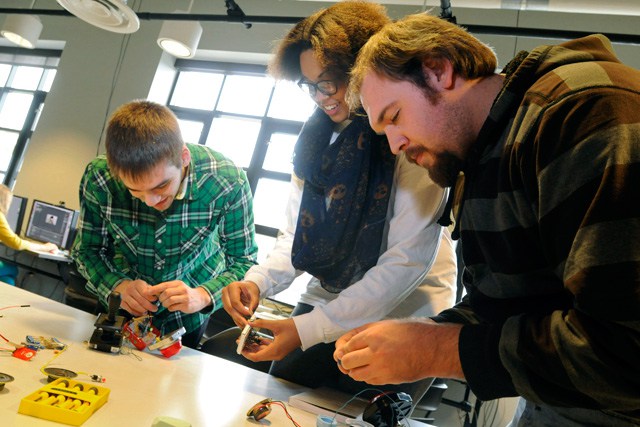
IMM majors learn a variety of skills. (Tcnj.edu)

The professors wanted the graduating students to use the knowledge they acquired to excel in a variety of professions, according to Pearson.

“We hoped that IMM would be a place of interdisciplinary collaboration that would also enrich its complementary disciplines,” she said. “We wanted it to be structured enough so that a student would have a firm foundation in writing, digital media and interactive computing, but flexible enough for each student to acquire depth and experience in the areas of the student’s choosing.”

Fast forward to 2017: IMM has become a popular major due to its adaptability, according senior IMM major Chris Lundy.

“IMM is a non-traditional major in the sense that we are always taking advantage of new technologies and constantly changing the curriculum to match trends of the various fields,” Lundy said.

Senior IMM major Ryan Laux agreed.

“Technology is at the core of IMM, and everything we do embraces the newest technologies that exist, from new camera gear, to 3D printing and virtual reality,” he said.

The lessons learned in IMM courses are applied to students’ everyday lives. For example, alumnus Joshua Lewkowicz (’15), an assistant animatic editor at DreamWorks Animation, acquired the bulk of his skills through his classes.

“After graduating from the IMM program, the technical knowledge of how to use and apply these programs was able to directly translate into the workflow and environment of DreamWorks Animation,” he said. “Whenever I run into a technical issue with a program, I am able to troubleshoot the problem myself.”

Technology is at the center of the IMM major. (Tcnj.edu)

Lundy believes both current and future IMM majors of different specializations will continue to explore the ever-changing digital landscape.

Laux agreed.

“The internet has certainly taken over much of the professional industry, and nearly everything we learn in IMM has an application in many avenues, from entertainment to advertising, to physical installations and even government,” Laux said.

Each year, the faculty sets a goal of attaining 15 new IMM majors, but Pearson is ecstatic that the program has exceeded their goal.

“It has been gratifying to see (the department) grow beyond our expectations,” Pearson said.

This year not only marks the IMM department’s largest graduating class, but the Fall 2016 semester welcomed the largest incoming freshman class, as well.

IMM was once a male-dominated field, so Lichtenberg was excited to see the incoming freshman class split 50-50 between male and female students.

“I know from talking with IMM women alum that this is particularly exciting, as (the former students) recall that their IMM classes had fewer women colleagues,” she said.

Although it is hard to predict the future, John Kuiphoff, an associate professor and chair of IMM, believes the program has a long and experimental future.

“I think we are going to continue to grow, and we are going to be able to offer even more,” Kuiphoff said. “My hope is that our students and alumni will help to create a future that is bright. I can’t wait to see what the next 10 years will bring.”

Editor’s note: This article reports that this year’s IMM graduating class is the largest in the College’s history, but it is, in fact, exactly the same size as last year’s graduating class. The department has had a 42 percent increase in graduates over the last few years, according to Kuiphoff.

“We’ll probably reach 200 majors within two years,” Kuiphoff said. “That’s really exciting, and it will allow us to do things that we couldn’t do before. … We really put everything we’ve got into making this the best major it can be.”

**This article was originally published in TCNJ’s The Signal on March 3, 2017**

Sammy’s Hope Hosts Halloween Event

** The following article was previously published in Quo Vadis on November 2, 2015 **


Sammy’s Hope Animal Welfare & Adoption Center will be hosting their first Halloween event on Saturday, Oct. 31 from 1:00 p.m. – 4:00 p.m. at their center located on 1400 Main Street (those using GPS should use the address 989 Main Street) in Sayreville to celebrate Halloween and also help animals find their forever homes.

While stores are stocking their shelves with everything Halloween related, from candy to costumes and even Halloween decorations, Sammy’s Hope Animal Welfare & Adoption Center in Sayreville is preparing to hold their Halloween event with hopes to try and help animals find their forever homes.

According to Dave Gaier of Sammy’s Hope, “We’re excited to host our first Halloween event, after opening just in January. Bring the kids—they’ll have fun, and families can experience the joy of bringing a dog, cat or kitten permanently into their homes. Or just drop by to visit us, and consider becoming a Sammy’s Hope volunteer, donor or just a friend. We welcome everyone… and so do our loving, sweet animals!”

Since black and orange are the colors for Halloween, and since black pets are harder to adopt out for a number of reasons, one being the common superstitions that surround black pets and black cats in particular, the adoption fees are reduced for black and orange cats and kittens.

Two animals at Sammy’s Hope that are looking for their forever homes are Sky, a black cat, and Tiger Lily, a black dog. According to Sammy’s Hope website, sammyshope.org, Sky is an adult cat that is a domestic short hair, and Tiger Lily is a young, female, Border Collie mix.

tiger-lily
Tiger Lily is a sweet, Border Collie mix that is ready to settle down with her forever home. (Photo Courtesy of David Gaier of Sammy’s Hope)

Sammy’s Hope’s website gives a short “bio” about the adoptable pets. When you click on Sky’s name, his bio says, “The first thing you will notice about Sky is his inquisitive bright yellow eyes set against a jet black coat. Sky is very intelligent and curious, exploring every nook and cranny that he can find.” They go on to say, “He loves to play and run around, but the thing that he loves the most is ‘hunting’ the mouse on the end of a wand toy, once he catches it, he will walk around carrying it dragging the wand behind him. He would do best with an experienced cat caregiver, and no small children. ”

Also on their website, the short bio for Tiger Lily says, “Come meet beautiful Tiger Lily! Lily loves to be where the people are, will happily sit for neck and chin scratches all day. She loves other dogs, who make her happy, playful nature shine through.” They go on to say, “Lily is a graduate of the American Society for the Prevention of Cruelty to Animals (ASPCA) Behavioral Rehab Center, where she participated in a program to help her overcome her fear of people. She has passed the program with flying colors and is now ready for a home of her very own. We just know she will bring joy to any family who welcomes her into their forever home.”

The inspiration behind the Halloween event is thanks to one of their board members. According to Gaier, “One of our board members, Naomi Milner, really loves Halloween and wanted to use the holiday to help us meet more people in the community and introduce them to our wonderful animals.” Gaier goes on to say, “Halloween is a wonderful day to visit Sammy’s and meet our adoptables.”

The Halloween event will be fun for everyone. There will be music, refreshments and a raffle where you will have the chance to win either a Kindle Fire HD6 or one of two LED TVs. As if the possible prizes aren’t good enough, there will also be dogs, cats and kittens that you could see, play with and adopt, helping Sammy’s Hope find their forever homes.

An important thing to note about Sammy’s Hope is that it is a private shelter. Sammy’s Hope takes in animals from other shelters and rescue organizations. Gaier said, “this allows the team at Sammy’s to provide extra attention and training for our dogs and cats, and also frees up space at those other shelters so they can care for more animals.” Gaier goes on to say, “We’re currently working with several organizations including Liberty Humane Society, the ASPCA and the Woodbridge Animal Shelter.” Help Sammy’s Hope celebrate Halloween and come to their event which will be filled with raffles, music and the opportunity to meet the faces behind Sammy’s Hope and their lovable animals.

** The following article was previously published in Quo Vadis on November 2, 2015 **

ASPCA Behavioral Rehabilitation Center continues success with more doggie graduates

Dogs in the ASPCA’s Behavioral Rehabilitation Center continue to successfully graduate their treatment programs with the hopes of finding their forever homes

** The following article was previously published in Quo Vadis on July 5, 2015 **

As the summer months approach and the thought of graduation appears in students’ minds, the ASPCA is also thinking about graduation. The only difference is that the ASPCA is not thinking about students graduating, they are thinking about dogs graduating.

The ASPCA has multiple treatment programs and, according to Emily Schneider, Director of Media & Communications for the ASPCA, “We have a group of dog ‘graduates’ who have successfully completed their treatment programs at the ASPCA Behavioral Rehabilitation Center, based in Madison, NJ.” Schneider goes on to describe their Rehabilitation Center by saying that the center “is the first-ever facility dedicated strictly to providing behavioral rehabilitation to canine victims of cruelty who suffer from severe fear and anxiety.”

Dealing with dogs that come from cruelty cases can be a hard task. Some of the dogs that are rescued sometimes suffer from such severe fear and anxiety due to their backgrounds that intervention from animal behavior experts become critical in addressing their issues and helping them become suitable for adoption.

This slideshow requires JavaScript.

**All photos in the above slideshow courtesy Sammy’s Hope and the ASPCA**

Schneider said, “At the center, a dedicated team of animal behavior experts work daily with these dogs until they could be made for adoption.” She goes on to say, “Scientifically sound techniques are used to reduce the dogs’ fear of people, as well as to gradually acclimate them to unfamiliar objects, sounds, living areas, and real-life situations that can induce trauma and severe stress.”

It takes time for the dogs to go through the treatment programs but Schneider says, “Once dogs graduate the program, they are placed with various animal shelters across the county to be adopted into loving homes.” Two of those shelters are Sammy’s Hope Animal Welfare & Adoption Center in Sayreville, and St. Hubert’s Animal Welfare Center in Madison, NJ.

According to David Gaier, Volunteer and Board Member for Sammy’s Hope, “While awaiting their adoptive families at Sammy’s Hope Animal Welfare & Adoption Center, ‘graduates’ continue to practice the skills they acquired at the Rehab Center, and receive several hours a day of individualized attention, doggie play groups, and life skills practice.”

Gaier goes on to say, “Sammy’s Hope Animal Welfare & Adoption Center has taken in 13 wonderful dogs from the ASPCA Behavioral Rehab Center since Jan. 11, 2015.” Through discussions between Emily Schneider and David Gaier, approximately 18 dogs were mentioned, and as of June 11, 2015, seven doggie graduates are looking for forever homes.

Only two named Janet and Little E remain available for adoption at Sammy’s Hope. However, there are other dogs at St. Hubert’s who are still looking for homes. “We were thrilled to see these dogs succeed in our program, and we’re so grateful to St. Hubert’s Animal Welfare Center and Sammy’s Hope Animal Welfare & Adoption Center for making their next steps on the road to recovery possible,” says Kristen Collins, ASPCA Senior Director of Anti-Cruelty Behavior Rehabilitation. Collins goes on to say, “Happy endings like these are a great example of the powerful work animal welfare organizations can do when we join forces to save lives.”

If you want more information on the ASPCA and their mission, please visit their website at aspca.org.

For more information on St. Hubert’s, visit sthuberts.org, or for Sammy’s Hope, visit sammyshope.org.


** The following article was previously published in Quo Vadis on July 5, 2015 **

Children’s Specialized Hospital to host the ninth annual Walk n’ Roll event

** The following article was originally published in Quo Vadis on May 2, 2015 **


Children’s Specialized Hospital will be hosting their ninth annual Walk n’ Roll event on May 16 from 8 a.m. to 12:30 p.m. at Johnson Park in Piscataway to raise money for their hospital.

The Walk n’ Roll event is free for those who participate.

“Walk n’ Roll is important because it is our largest community event. It is a wonderful opportunity to have our patients and their families support the hospital in a fun way,” said Toni Bodrato, the event coordinator for Children’s Specialized Hospital. “We invite our participants to walk or roll a 1, 2.5, or 5 mile course while enjoying the beautiful scenery of Johnson Park and the Raritan River. The Walk n’ Roll is followed by a carnival for young and old, where everyone can enjoy live music, games and prizes.”

Bodrato also said, “We have a few goals for this event. We are excited to welcome around 2,200 walkers this year—made up of patients, families, friends, and sponsors. We also have the goal to hit a record high for fundraising of $278,000. Last year’s event raised $267,000 to help fund the expansion of our New Brunswick in-patient program so we are able to treat more children. Each year the money raised by our sponsors and teams help to support a project to better our services and care for children in need.”

sneaker-picture
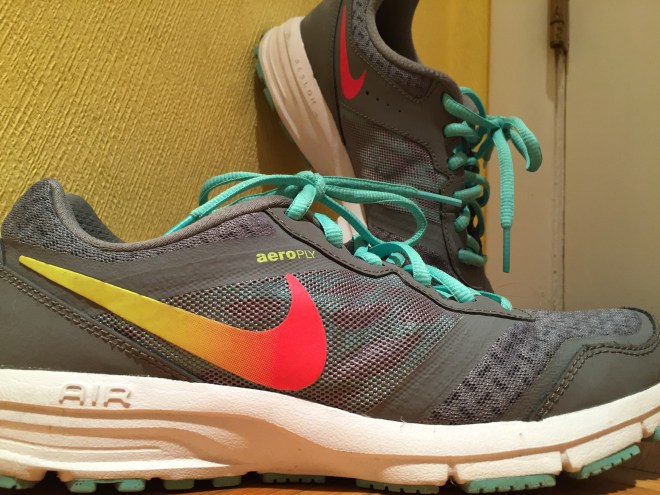
Participants can walk or roll through any of the races scheduled. (Picture courtesy Hannah Fakhrzadeh)

All the donations made during the event will go to benefit the Children’s Specialized Hospital, which has hospitals at 12 sites in New Jersey. The closest one is on Somerset Street in New Brunswick.

The hospital’s website, childrens-specialized.org says, “The hospital serves children affected by brain injury, spinal cord dysfunction and injury, premature birth, autism, developmental delays, and life-changing illnesses.” They go on to say, “Renowned therapeutic programs include physical, speech, and occupational therapy; psychology services; neurodevelopmental physician services; recreational therapy and child life, and a full complement of support services.”

** The following article was originally published in Quo Vadis on May 2, 2015 **

Potholes cause problems for drivers in the Middlesex County area

** The following article was previously published in Quo Vadis on April 19, 2015 **


Potholes have been affecting New Jersey drivers every day. These potholes can be seen all around local streets near The College. They cause pricey damages because sometimes they are nearly invisible, causing costly damages to vehicles.

Potholes are popping up every where especially after winter weather conditions

Potholes have become a major issue due to the severe winter Middlesex County has experienced. According to the state of New Jersey’s Department of Transportation website, potholes happen when moisture from rain or melting snow pierces the road surface and freezes, causing the pavement to crack. Sudden temperature changes that cause a “freeze – thaw” cycle create outbreaks of potholes. During the winter, a temporary patch is used and later replaced with a permanent patching material. This is the reason why a majority of potholes form immediately after weather like the one Middlesex County has faced.

The drive to The College can be a puzzle with all the potholes on Route1 and on roads closer to the College like Woodbridge Avenue. As a matter of fact, the website of the radio station NJ 101.5 lists Edison as the New Jersey city with the biggest potholes.


img_4536
Potholes can proves to be a dangerous and costly obstacle while driving. (Photo courtesy Hannah Fakhrzadeh)


Students at the College sometimes try to avoid the daily traffic of Woodbridge Avenue by taking the shortcut through Executive Avenue. The problem with this shortcut is the massive potholes that can emerge on the drive. Winter weather could be one of the causes of these potholes but the constant truck traffic also plays a major role in the creation of these potholes. The massive potholes around the College can cause costly damage. Eric Canavera, a frequent driver of the area surrounding The College, said, “I drive my wife to and from the College daily. We had spent over $2000 to have work on our car including a wheel alignment in November.” Canavera said that he understands that there has been bad weather but he also said, “At the same time many of the potholes are ones from last year that were not fixed. Coming out of the side of The College on Mills Road is a pothole that has been there since 2013 and it is getting bigger each year.”

The major damage that the potholes are causing is getting the attention of New Jersey lawmakers. According to News12.com, “Motorists are expected to pay thousands in repairs sustained from potholes.” They also say that the Department of Transportation- says it plans to spend around $4 million on pothole repair for state roads.

To speed up the process of repairing these potholes, motorists are urged to report potholes that they notice. This will speed up the repairs by allowing the local government to focus on specific problem areas. According to the New Jersey’s Department of Transportation website, “If you are reporting a pothole for the Garden State Parkway or the New Jersey Turnpike, please complete the form on the New Jersey Turnpike Authority website.” They also say that if the road is not listed under the “Interstate/Route” pull down menu, the road may be under county rather than state jurisdiction. Potholes should be reported to the appropriate County Pothole Hotline. The Middlesex County Pothole Hotline is 732-940-3800.


img_4537
What might seem like a small problem in the road can become an almost $1000 repair later on. (Photo courtesy Hannah Fakhrzadeh)
** The following article was previously published in Quo Vadis on April 19, 2015 **