Muslim panel answers anonymous questions

**This article was originally published in The Signal on April 17, 2017**

By Hannah Fakhrzadeh
Staff Writer

“I don’t feel oppressed. I feel liberated.”

For Abrar Ebady, a senior biology major, wearing a hijab is not how the media portrays it. While wearing the hijab started at a young age for Edady, it is ultimately her choice to continue.

“The hijab is really about modesty,” said Farsha Rizwan, a senior biology major.

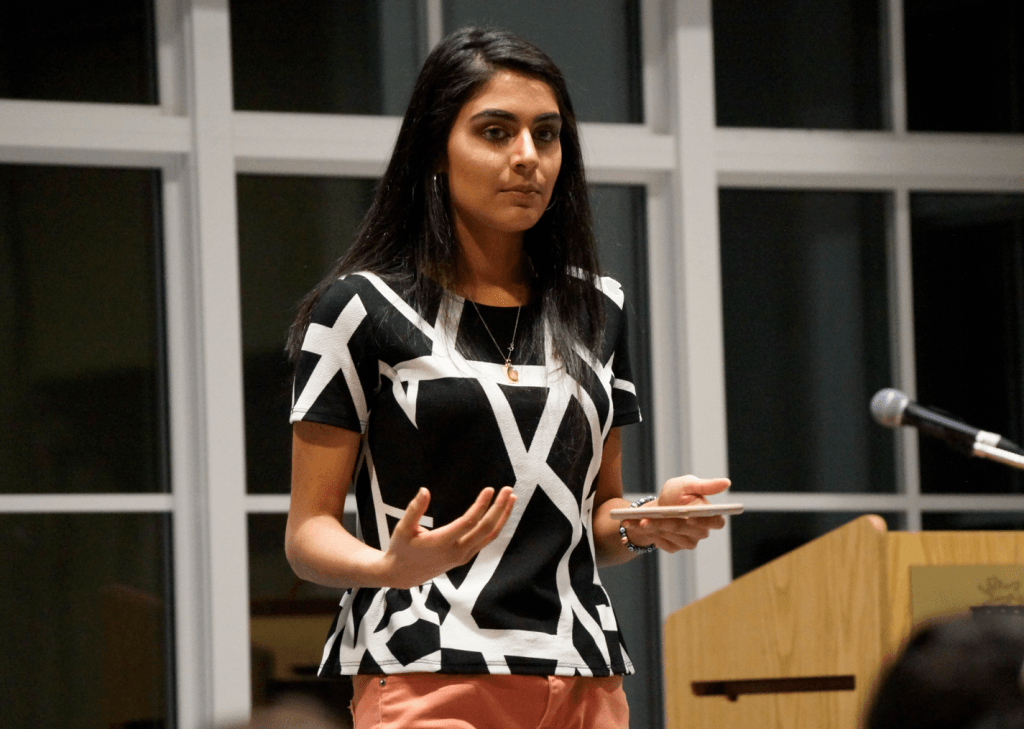
Hosted by the Muslim Students’ Association, “Ask A Muslim” was held on Wednesday, April 12. It provided students the opportunity to ask questions to a panel consisting of students and two special guests about the misconceptions of Islam and life as a Muslim in America.

“(The event) is a great way to learn about another religious group on campus and it provides students and faculty alike (the chance) to have their questions answered,” said Zahra Memon, MSA’s public relations co-chair and a sophomore deaf education and iSTEM double major.

At the event, questions were anonymously submitted to ensure students felt comfortable asking about a range of topics.

“We want everyone to be honest with asking whatever they are curious about,” said Alizeh Shamshad, MSA’s public relations co-chair and a sophomore biology major. “By keeping it anonymous, nobody needs to worry about potentially offending someone due to their question, as we would love to answer every question you have. No question is offensive, as the end goal of each question is to develop a greater understanding and facilitate awareness.”
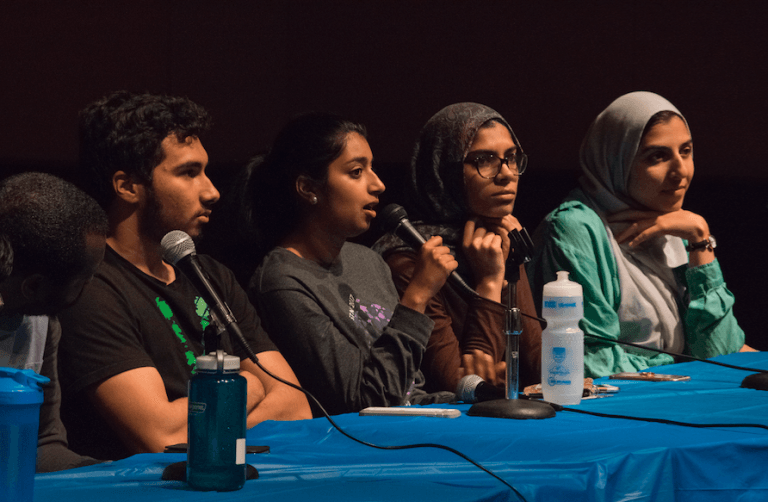
Panelists share what it’s like to be Muslim in America. (Jason Proleika / Photo Editor)

Sameera Chaudry, a general member of MSA and a junior biology major, agreed.

“This kind of open discussion can serve to unite the TCNJ community by fostering an atmosphere of understanding and unity,” she said.

Dr. Mateen Khan, a guest speaker, physician and a Muslim community leader who has dedicated his life to studying and teaching the Quran, believes the panel helped students better understand each other.

“Panels like these help to break down these walls and help us understand one another as fellow human beings,” he said. “Islam is a beautiful religion which over a billion people attribute themselves to. It is worth sharing and understanding.”

Yaseen Ayuby, a panelist and a junior applied mathematics major, reminded the audience to learn for themselves and to “take what you see on the media with a grain of salt.”

Ebady further explained educating oneself and directed the audience to a book titled “The Sealed Nectar” in which she calls, “a beautiful interpretation of Islam.”

The second guest speaker, Kieran Webster, a Rutgers University–New Brunswick graduate student studying business strategy and human resource management, loves the journey Islam has taken him on. Webster wasn’t born into an Islamic family. Instead, he made the choice to convert from Christianity to Islam about three years ago.

“Islam is a religion of logic. The foundation of our religion is ‘as salaamu `alaykum’ which means ‘May the peace and security of God be upon you.’” Webster said. “It elevates us beyond bias, prejudice or bigotry because with this greeting, we are made aware that we worship one God and we seek peace by being peaceful with one another.”

After a question inquired about the injustices of the panelists, Ebady and Nawal Mubin, a sophomore communication studies major, shared their stories.

Mubin described a moment she had with a supermarket shopper. She said, at first, she was unsure how the interaction would pan out. She soon realized that the woman was genuinely interested in learning about her culture.

Ebady recalls a time she passed a group of guys on her walk home from a party. As she passed, she heard them call out “terrorist.”

“I was genuinely afraid for my life,” Ebady said.

While the event allowed the panelists to share their stories, it also became a learning experience for both the audience and panelists.

“I learned more about my religion than I expected tonight,” said Roshaan Iqbal, a sophomore biology major and one of the student panelists for the event. “There were some concepts about my religion that I didn’t even fully understand, and even I got some of those concepts and ideas cleared up.”

Liana Shehata, MSA’s historian and a sophomore psychology major, said Muslim Americans are just average Americans.

“We go through the same struggles and live our lives normally here in the States — we just have beliefs and cultures that differ from the Western culture, and different isn’t necessarily bad,” she said.

**This article was originally published in The Signal on April 17, 2017**
Students talk injustice at monologues

**This article was originally published in The Signal on April 10, 2017**

By Hannah Fakhrzadeh
Staff Writer

“We close our eyes so we don’t have to see the children’s blood-soaked school uniforms, their still sizzling flesh or their bodies contorted in terrible positions.”

For junior biology major Sameera Chaudhry, the horrible scenes displayed in the media of war-torn Syria and the innocent faces of lives that were lost are forever etched in her mind.

Chaudhry discussed the daily injustices that occur around the world, yet most people choose to turn a blind eye.

Students gathered on Thursday, April 6, in the Education Building to hear the Muslim Students’ Association’s Justice Monologues, where students discussed issues of injustice, both in their lives and around the world.

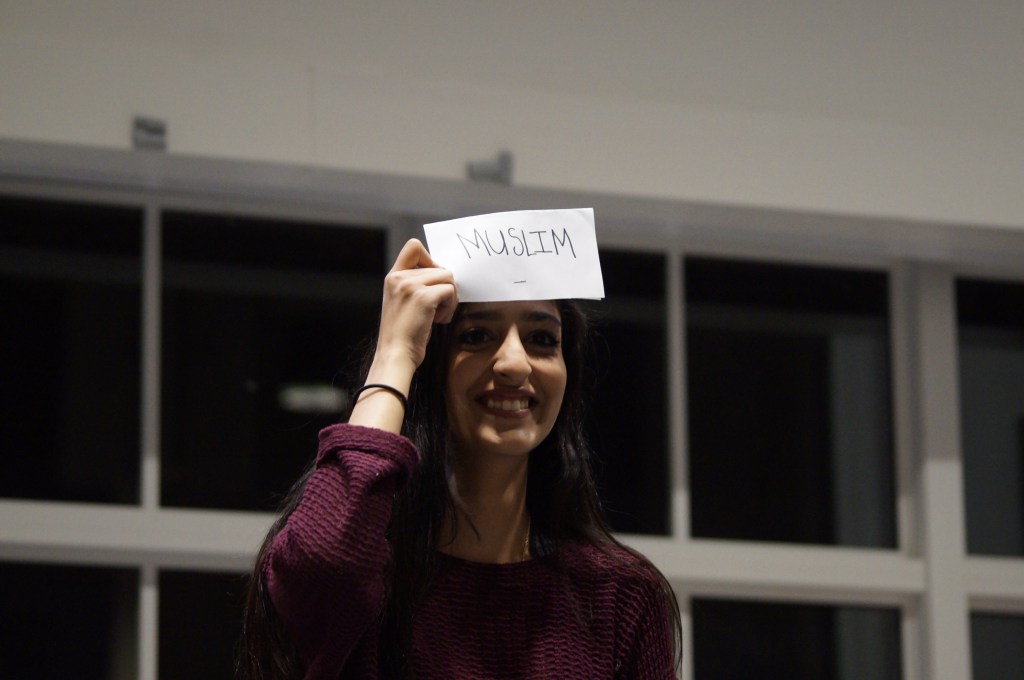
Student embraces muslim identity. (Meagan McDowell / Staff Photographer)

In her monologue, Nawal Mubin, a sophomore communication studies major, pointed out that our nation has witnessed various movements supporting minorities that don’t feel equally represented.

“We say everyone is equal, but we still have (so many) movements for minorities,” she said.

Mubin also brought up the lack of justice in cases like the shooting of Trayvon Martin.

“How can we sit back when we know innocent lives are taken every day?” she asked the audience.

Kyle Kulaga, a freshman career and community studies major, shared a touching story about struggling with his hearing disability in school because some of his teachers did not use American Sign Language in their classes.

“Do you think it’s fair for someone with hearing loss to go through what I went through?” he asked. “I don’t think so, and I want people to know that American Sign Language was a big part of my life.”

Iman Khan, a sophomore biology major, shared an empowering story of overcoming differences in her monologue entitled, “A Triumph of the Conscience.”

“Why am I different? What makes me different?” Khan remembers asking in regard to her darker hair and skin.

Eventually, Khan realized that she should be proud of her identity and not let the opinions of others affect how she sees herself.

Monologues encourage open-mindedness. (Meagan McDowell / Staff Photographer)

“I am me and me is what they will see,” she said.

Matthew Hardy, a senior sociology and women’s, gender and sexuality studies double major, explained an enlightening encounter he had with a Muslim man who gave him a Holy Quran.

“We are all humans,” he said. “I encourage everyone to really listen because you never know what you will learn.”

The Justice Monologues not only provided students the opportunity to tell their stories, but inspire those in attendance, as well. Engy Shaaban, a junior special education and psychology double major, developed a new perspective following the event.

“I think in this day and age, ignorance and especially close-mindedness can be so incredibly dangerous,” she said. “For me, coming to these sorts of events is a way to be exposed to different perspectives that I might not typically have access to.”

The feeling was mutual for Zainab Rizvi, a member of MSA and a junior elementary education and women’s, gender and sexuality studies double major.

“Many people live in their own bubble, and it’s important that they come out and hear the experiences of others,” she said. “It’s a way to appreciate the lives of others and understand that people come from all backgrounds.”

Zahra Memon, MSA’s public relations chair and a sophomore deaf education and iSTEM double major, shared her thoughts on the event.

“We’ve all faced some type of injustice in our lives, and even if we haven’t, someone who shares our ethnicity or culture has been affected in some way,” she said. “The Justice Monologues are a way for all of us to come together and hear the stories of students who have felt injustice.”

Memon believes it is important for students to empathize with their peers.

“We often forget to put ourselves in the other person’s shoes, however, this event will give us the chance to see the other end of the lens,” she said.

**This article was originally published in The Signal on April 10, 2017**

IMM celebrates largest graduating class

**This article was originally published in TCNJ’s The Signal on March 3, 2017**

By Hannah Fakhrzadeh
Staff Writer

Due to heightened interest in interactive multimedia, the College’s department will celebrate its biggest graduating class.

This May, students will take part in IMM history, according to Rachel Lichtenberg, the IMM department’s program assistant.

“IMM had three graduating seniors in its first class, and we will now have 44 graduating seniors,” she said.

There are currently about 160 IMM majors and 60 minors.

In 2001, IMM became a major at the College thanks to the hard work of Kim Pearson, an associate professor of journalism and professional writing, Phillip Sanders, a professor of art and interactive multimedia, and Ursula Wolz, an associate professor of computer science.

Their goal was to connect JPW with the growing field of technology, so they began the lengthy process of writing a proposal.

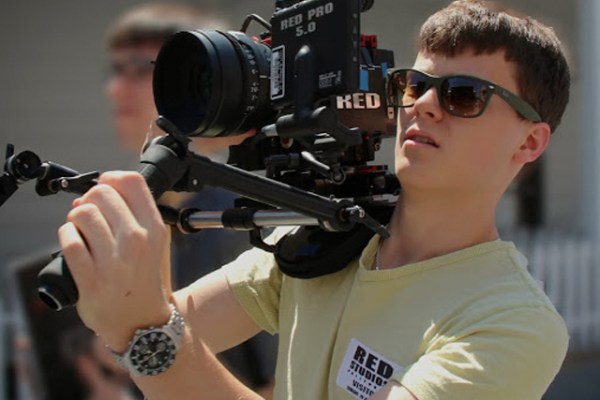
IMM majors learn a variety of skills. (Tcnj.edu)

The professors wanted the graduating students to use the knowledge they acquired to excel in a variety of professions, according to Pearson.

“We hoped that IMM would be a place of interdisciplinary collaboration that would also enrich its complementary disciplines,” she said. “We wanted it to be structured enough so that a student would have a firm foundation in writing, digital media and interactive computing, but flexible enough for each student to acquire depth and experience in the areas of the student’s choosing.”

Fast forward to 2017: IMM has become a popular major due to its adaptability, according senior IMM major Chris Lundy.

“IMM is a non-traditional major in the sense that we are always taking advantage of new technologies and constantly changing the curriculum to match trends of the various fields,” Lundy said.

Senior IMM major Ryan Laux agreed.

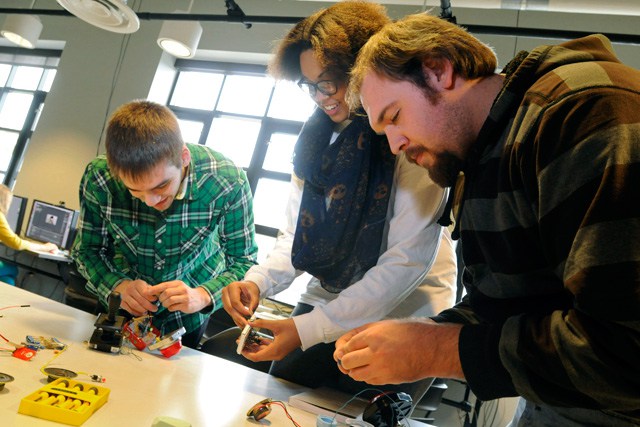
“Technology is at the core of IMM, and everything we do embraces the newest technologies that exist, from new camera gear, to 3D printing and virtual reality,” he said.

The lessons learned in IMM courses are applied to students’ everyday lives. For example, alumnus Joshua Lewkowicz (’15), an assistant animatic editor at DreamWorks Animation, acquired the bulk of his skills through his classes.

“After graduating from the IMM program, the technical knowledge of how to use and apply these programs was able to directly translate into the workflow and environment of DreamWorks Animation,” he said. “Whenever I run into a technical issue with a program, I am able to troubleshoot the problem myself.”

Technology is at the center of the IMM major. (Tcnj.edu)

Lundy believes both current and future IMM majors of different specializations will continue to explore the ever-changing digital landscape.

Laux agreed.

“The internet has certainly taken over much of the professional industry, and nearly everything we learn in IMM has an application in many avenues, from entertainment to advertising, to physical installations and even government,” Laux said.

Each year, the faculty sets a goal of attaining 15 new IMM majors, but Pearson is ecstatic that the program has exceeded their goal.

“It has been gratifying to see (the department) grow beyond our expectations,” Pearson said.

This year not only marks the IMM department’s largest graduating class, but the Fall 2016 semester welcomed the largest incoming freshman class, as well.

IMM was once a male-dominated field, so Lichtenberg was excited to see the incoming freshman class split 50-50 between male and female students.

“I know from talking with IMM women alum that this is particularly exciting, as (the former students) recall that their IMM classes had fewer women colleagues,” she said.

Although it is hard to predict the future, John Kuiphoff, an associate professor and chair of IMM, believes the program has a long and experimental future.

“I think we are going to continue to grow, and we are going to be able to offer even more,” Kuiphoff said. “My hope is that our students and alumni will help to create a future that is bright. I can’t wait to see what the next 10 years will bring.”

Editor’s note: This article reports that this year’s IMM graduating class is the largest in the College’s history, but it is, in fact, exactly the same size as last year’s graduating class. The department has had a 42 percent increase in graduates over the last few years, according to Kuiphoff.

“We’ll probably reach 200 majors within two years,” Kuiphoff said. “That’s really exciting, and it will allow us to do things that we couldn’t do before. … We really put everything we’ve got into making this the best major it can be.”

**This article was originally published in TCNJ’s The Signal on March 3, 2017**

Choir shares stage with tsunami survivors

**This article was originally published in The Signal on April 5, 2016**


The College’s choir had the opportunity to sing alongside Japanese tsunami survivors on Tuesday, March 29, at New York City’s Lincoln Center to benefit the survivors.

Music Department Chair, Associate Professor and Director of Choirs John Leonard led the choir during its performance in the center’s Frederick P. Rose Hall, which seats 1,300 spectators, according to rosecompanies.com.

In an nj.com article from Tuesday, March 29, Leonard said that around 90 of his students joined 130 Japanese teenagers on stage to sing during the concert.

Among the students from the College that sang on stage was sophomore music education major Ryan Price.

“We sang Gustav Mahler’s second symphony, otherwise known as the ‘Resurrection Symphony,’ as well as Mozart’s ‘Ave Verum Corpus’ and the ‘Hand in Hand Theme Song,’” Price said.

The choir performed with high school students from Fukushima, Japan, according to sophomore violin music education major Lorena LiMato.

A little over five years ago, “the Great East Japan earthquake shook the country’s pacific coast, causing 133-foot tsunami waves and a slew of death and destruction,” according to the same nj.comarticle.

As with any concert of this magnitude, there was a lot of preparation.

“It was a little monotonous at first — going to extra rehearsals, amongst all of the other classes I’m taking as a music major,” LiMato said. “But I feel that the week before the concert, we started getting more excited because it was more tangible.”

LiMato described the experience of being able to work with the Japanese students in person.

“Once the Japanese students came and we ran through it with them, it got more intense because we finally got to meet and work with them face-to-face,” she said. “Even though there was a language barrier, there was definitely a sense of camaraderie amongst everyone because we all felt strongly about this performance.”

The concert not only paid respect to those whose lives were affected by the earthquake and tsunami, but also allowed for both the College and Japanese students to form friendships through a shared talent.

“This concert was just one of many that united American and Japanese students together to bond and make friendships over music, which has no cultural or linguistic boundaries,” Price said. “These Japanese students have probably seen more terror and pain than any of us will ever see. These students are from the region of Japan that suffered from earthquakes and tsunamis and watched family members (get) washed away. Yet they were so enthusiastic and excited to sing with us. This performance connected us in a way that no other medium of expression could ever do.”

The choir was excited to perform at a such an iconic place like Lincoln Center with friends from the College and new friends from Japan, freshman history major Kyle Elphick said.

“It doesn’t get much bigger than performing at Lincoln Center and I am grateful that I was given the opportunity to sing on such a stage,” Elphick said.

Along with excitement came a lot of nerves, as the choir knew the pressure was on.

“I was most nervous about making sure our pieces sounded professional,” Elphick said. “Our group, of course, had the ability to master the notes and rhythms, but I hoped that we would sound like we belonged at a venue like Lincoln Center. We definitely met that challenge.”

In addition to the prestigious venue, part of the song, “Hand in Hand,” was in Japanese.

“I was definitely most nervous about the diction,” LiMato said. “It was a little intimidating to make sure I knew all the correct words and syllables and how they fit into the rhythms of the musical phrases.” 

Overall, junior music education major Joanna Ju believes the concert was a great success and opportunity.

“Despite the language barriers, Japanese and American students were able to work together and create beautiful music,” Ju said. “I think that says a lot about how powerful music is in bringing people from diverse backgrounds together. These types of experiences create a sense of unity, which can give people the hope and strength they need to move forward.”

**This article was originally published in The Signal on April 5, 2016**

Self-design majors create variety for students

**This article was originally published in The Signal on January 29, 2017**


Struggling to decide on a major at the College? No problem.

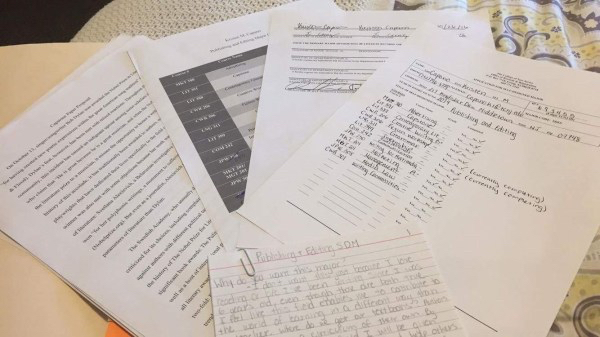
The Self-Design Major Committee allows students to create their own major with the help of advisers. Alongside a faculty member, students can plan out their major course by course.

English Professor Jo Carney explained the process.

“After we agree on a design and curriculum, the student submits a proposal to the Self-Design Major Committee for approval,” Carney said.

A self-designed major is not as structured as a traditional major because it allows students flexibility when it comes to the courses they choose to take. A self-designed major allows students to broaden their knowledge on topics that they may not have had the chance to explore if they had chosen a traditional major.

“Self-designing a major has allowed me to take a wide variety of courses,” said Jackie Delaney, a former member of The Signal staff and a junior English and publishing and editing major. “I’ve been able to take classes that I would not have normally taken if I was in a specific major or minor.”

Within her publishing and editing major, Delaney took a variety of courses in communications, English, creative writing and journalism.

Delaney never imagined designing her own major, but now she loves the path she chose.

“I always knew I wanted to pursue a degree in English, but it wasn’t until I came to the College that I realized I could design my own major alongside English,” she said.

imm-photo
Students must file paperwork to design their own major. (Photo Courtesy of Kristen Capano)

Kristen Capano, a junior English and publishing and editing major, wasn’t aware that the self-design path was a possibility when she first came to the College.

Thanks to fellow students, Capano made the decision to design her own major.

“About halfway through my sophomore year, I met a few upperclassmen who were in the program and convinced me to join,” Capano said. “My main concern was, ‘What if I’m limiting myself to something too specific?’ But I decided if you know what you want to do and have a passion for it, then you should take the leap.”

Carney agrees with Capano and believes students should choose the self-design path, especially those who attend a liberal arts college.

“Students who take the initiative to design a major around an area of academic interest are demonstrating the best of a liberal arts mission: to explore an area of intellectual curiosity,” Carney said. “The second reason is more pragmatic. (Self-designed majors) are often a path to professional situations and employment post-college.”

Capano said the program is nothing like what she expected. In fact, Capano was uneasy when she initially thought about designing her major.

“The thought of (designing my own major) intimidated me because I thought it was going to be a long, painful process that would haunt me throughout my college career and be finalized just in time for graduation,” Capano said. “But, with the help of my adviser, the progression became much less stressful and even a little fun.”

While self-designing your own major is a lot of work, it can be extremely rewarding. Maria Printon, a senior cognitive science major, advises students to ensure a self-designed major is their best option before finalizing the details.

“It’s a lot of work,” Printon said. “Nonetheless, it is very rewarding because you’re designing your own path of study. Nobody has ever done exactly what you’re doing, and that’s a huge accomplishment.”

Capano agreed.

“Make sure you know what you want to do. It’s a lot of work and stress to decide later on that you’d rather work in a different field,” she said. “On the other hand, it’s a very rewarding experience… and it’s also pretty cool to be the only one in the College with your exact major.”

Capano also recommended the self-design program for students who feel their education may be lacking something essential for their desired career path.

“The people are so kind and just want to see you succeed,” she said. “I found my home in the self-design department.”

**This article was originally published in The Signal on January 29, 2017**