Choir shares stage with tsunami survivors

**This article was originally published in The Signal on April 5, 2016**


The College’s choir had the opportunity to sing alongside Japanese tsunami survivors on Tuesday, March 29, at New York City’s Lincoln Center to benefit the survivors.

Music Department Chair, Associate Professor and Director of Choirs John Leonard led the choir during its performance in the center’s Frederick P. Rose Hall, which seats 1,300 spectators, according to rosecompanies.com.

In an nj.com article from Tuesday, March 29, Leonard said that around 90 of his students joined 130 Japanese teenagers on stage to sing during the concert.

Among the students from the College that sang on stage was sophomore music education major Ryan Price.

“We sang Gustav Mahler’s second symphony, otherwise known as the ‘Resurrection Symphony,’ as well as Mozart’s ‘Ave Verum Corpus’ and the ‘Hand in Hand Theme Song,’” Price said.

The choir performed with high school students from Fukushima, Japan, according to sophomore violin music education major Lorena LiMato.

A little over five years ago, “the Great East Japan earthquake shook the country’s pacific coast, causing 133-foot tsunami waves and a slew of death and destruction,” according to the same nj.comarticle.

As with any concert of this magnitude, there was a lot of preparation.

“It was a little monotonous at first — going to extra rehearsals, amongst all of the other classes I’m taking as a music major,” LiMato said. “But I feel that the week before the concert, we started getting more excited because it was more tangible.”

LiMato described the experience of being able to work with the Japanese students in person.

“Once the Japanese students came and we ran through it with them, it got more intense because we finally got to meet and work with them face-to-face,” she said. “Even though there was a language barrier, there was definitely a sense of camaraderie amongst everyone because we all felt strongly about this performance.”

The concert not only paid respect to those whose lives were affected by the earthquake and tsunami, but also allowed for both the College and Japanese students to form friendships through a shared talent.

“This concert was just one of many that united American and Japanese students together to bond and make friendships over music, which has no cultural or linguistic boundaries,” Price said. “These Japanese students have probably seen more terror and pain than any of us will ever see. These students are from the region of Japan that suffered from earthquakes and tsunamis and watched family members (get) washed away. Yet they were so enthusiastic and excited to sing with us. This performance connected us in a way that no other medium of expression could ever do.”

The choir was excited to perform at a such an iconic place like Lincoln Center with friends from the College and new friends from Japan, freshman history major Kyle Elphick said.

“It doesn’t get much bigger than performing at Lincoln Center and I am grateful that I was given the opportunity to sing on such a stage,” Elphick said.

Along with excitement came a lot of nerves, as the choir knew the pressure was on.

“I was most nervous about making sure our pieces sounded professional,” Elphick said. “Our group, of course, had the ability to master the notes and rhythms, but I hoped that we would sound like we belonged at a venue like Lincoln Center. We definitely met that challenge.”

In addition to the prestigious venue, part of the song, “Hand in Hand,” was in Japanese.

“I was definitely most nervous about the diction,” LiMato said. “It was a little intimidating to make sure I knew all the correct words and syllables and how they fit into the rhythms of the musical phrases.” 

Overall, junior music education major Joanna Ju believes the concert was a great success and opportunity.

“Despite the language barriers, Japanese and American students were able to work together and create beautiful music,” Ju said. “I think that says a lot about how powerful music is in bringing people from diverse backgrounds together. These types of experiences create a sense of unity, which can give people the hope and strength they need to move forward.”
**This article was originally published in The Signal on April 5, 2016**

Self-design majors create variety for students

**This article was originally published in The Signal on January 29, 2017**


Struggling to decide on a major at the College? No problem.

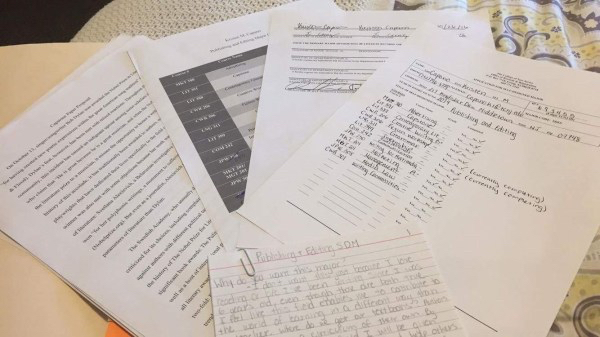
The Self-Design Major Committee allows students to create their own major with the help of advisers. Alongside a faculty member, students can plan out their major course by course.

English Professor Jo Carney explained the process.

“After we agree on a design and curriculum, the student submits a proposal to the Self-Design Major Committee for approval,” Carney said.

A self-designed major is not as structured as a traditional major because it allows students flexibility when it comes to the courses they choose to take. A self-designed major allows students to broaden their knowledge on topics that they may not have had the chance to explore if they had chosen a traditional major.

“Self-designing a major has allowed me to take a wide variety of courses,” said Jackie Delaney, a former member of The Signal staff and a junior English and publishing and editing major. “I’ve been able to take classes that I would not have normally taken if I was in a specific major or minor.”

Within her publishing and editing major, Delaney took a variety of courses in communications, English, creative writing and journalism.

Delaney never imagined designing her own major, but now she loves the path she chose.

“I always knew I wanted to pursue a degree in English, but it wasn’t until I came to the College that I realized I could design my own major alongside English,” she said.

imm-photo
Students must file paperwork to design their own major. (Photo Courtesy of Kristen Capano)

Kristen Capano, a junior English and publishing and editing major, wasn’t aware that the self-design path was a possibility when she first came to the College.

Thanks to fellow students, Capano made the decision to design her own major.

“About halfway through my sophomore year, I met a few upperclassmen who were in the program and convinced me to join,” Capano said. “My main concern was, ‘What if I’m limiting myself to something too specific?’ But I decided if you know what you want to do and have a passion for it, then you should take the leap.”

Carney agrees with Capano and believes students should choose the self-design path, especially those who attend a liberal arts college.

“Students who take the initiative to design a major around an area of academic interest are demonstrating the best of a liberal arts mission: to explore an area of intellectual curiosity,” Carney said. “The second reason is more pragmatic. (Self-designed majors) are often a path to professional situations and employment post-college.”

Capano said the program is nothing like what she expected. In fact, Capano was uneasy when she initially thought about designing her major.

“The thought of (designing my own major) intimidated me because I thought it was going to be a long, painful process that would haunt me throughout my college career and be finalized just in time for graduation,” Capano said. “But, with the help of my adviser, the progression became much less stressful and even a little fun.”

While self-designing your own major is a lot of work, it can be extremely rewarding. Maria Printon, a senior cognitive science major, advises students to ensure a self-designed major is their best option before finalizing the details.

“It’s a lot of work,” Printon said. “Nonetheless, it is very rewarding because you’re designing your own path of study. Nobody has ever done exactly what you’re doing, and that’s a huge accomplishment.”

Capano agreed.

“Make sure you know what you want to do. It’s a lot of work and stress to decide later on that you’d rather work in a different field,” she said. “On the other hand, it’s a very rewarding experience… and it’s also pretty cool to be the only one in the College with your exact major.”

Capano also recommended the self-design program for students who feel their education may be lacking something essential for their desired career path.

“The people are so kind and just want to see you succeed,” she said. “I found my home in the self-design department.”

**This article was originally published in The Signal on January 29, 2017**